

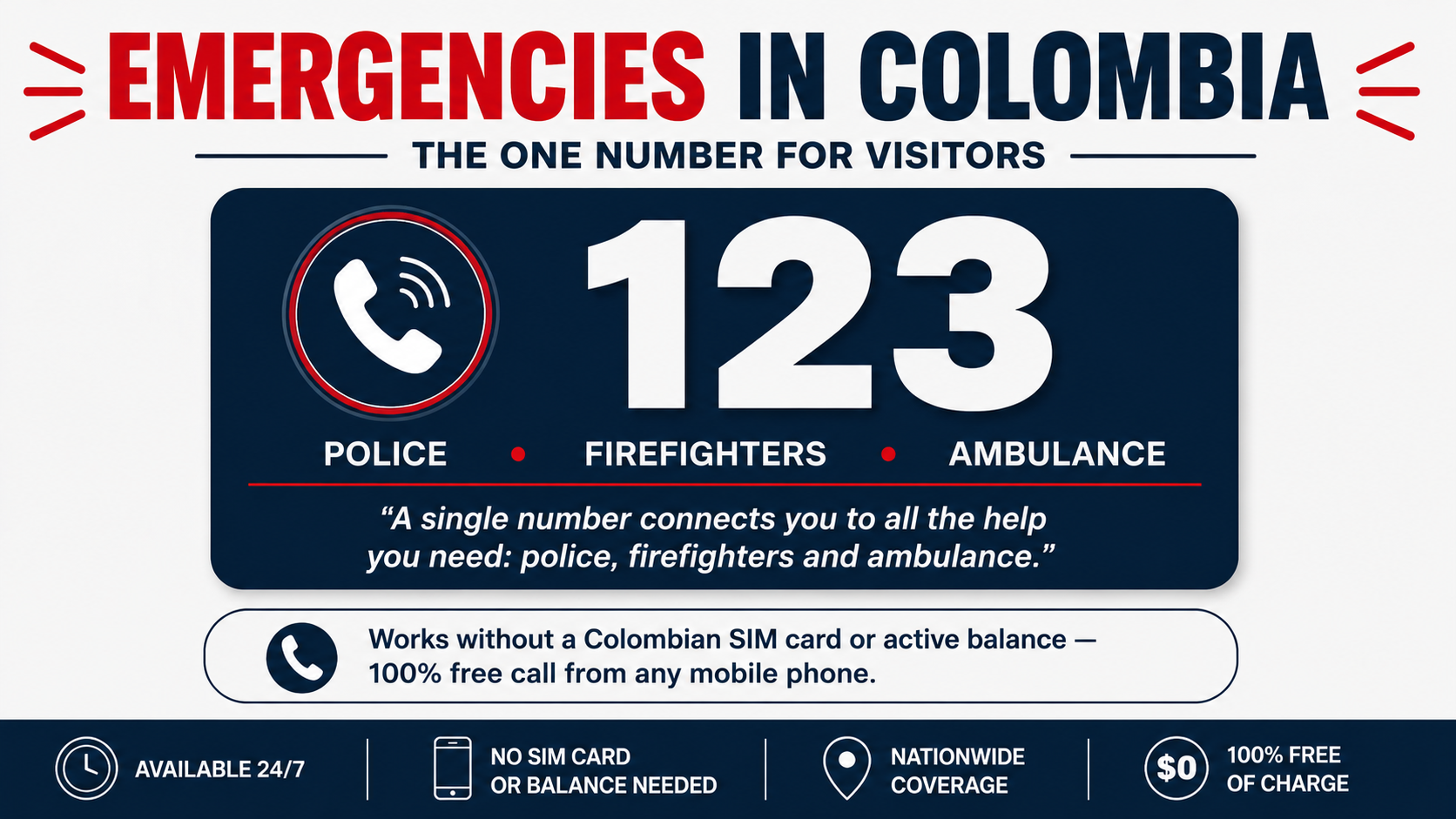
Before traveling to Colombia, there is one number you must memorize: 123. It is the Número Único de Seguridad y Emergencias (NUSE — National Emergency and Safety Number) and connects, from any mobile or landline phone in the country, with police, ambulance, fire department and rescue services — free, 24 hours a day, without needing a Colombian SIM card or registering anywhere.
Dial 123 first. Everything else in the Colombian emergency system is built from that single entry point.
What 123 does (and doesn't cover on its own)
When you call 123, an operator routes your call to the appropriate service based on what you describe: a medical emergency, a fire, an ongoing robbery or a traffic accident with injuries. Cities like Bogotá and Medellín have their own coordination centers to process these calls quickly.
However, there are three types of emergency that are handled more efficiently by specialized direct lines:
- 165 (GAULA): extortion or kidnapping threats.
- 141 (ICBF): child protection emergencies.
- 155: gender-based violence response line.
The reason is simple: a specialized unit can activate the correct protocol faster than a general operator who needs to transfer the call — and in cases of kidnapping or extortion, speed and discretion are decisive.
The language barrier
Operators at 123 work primarily in Spanish, and not all cities or all hours guarantee English-language assistance. If you don't speak Spanish, the fastest way to overcome that barrier is to have a short, fixed script ready before calling: first your location (address, neighborhood or a visible landmark), then the type of emergency, and then the service you need — using words like "ambulancia", "policía" or "bomberos", which operators recognize even with a foreign accent.
In Bogotá there is also a Tourist Police line dedicated to foreign visitors: +57 601 337 4413, specialized in robbery cases, lost documents and incidents in tourist areas.
Your embassy and travel insurance
123 does not replace your embassy or travel insurance — each covers different things:
- US Embassy (Bogotá): +57 601 275 2000
- Canadian Embassy (Bogotá): +57 601 657 9800
- British Embassy: FCDO global emergency line +44 1908 516666
Embassies help with emergency document replacement, hospital guidance and notifying relatives — functions outside the scope of 123.
If you have international travel insurance, providers such as Assist Card (+57 1 307 8079) or International SOS (+57 1 634 9090, Bogotá) offer medical coordination in English, access to private clinics and medical repatriation when the public system cannot provide the level of specialized care you need.
Additional tools in Bogotá and Medellín
Bogotá upgraded its 123 center with real-time video technology, allowing callers to stream video directly to operators. Medellín, for its part, handles non-urgent security inquiries via WhatsApp at 301 604 4444 — useful when it's faster to show a situation than to explain it over the phone.
Dial 123 first, but knowing these additional layers turns an emergency into a manageable process rather than an improvisation.
Our commitment: bilingual support for those who need it
At Ecotours Colombia, we know that the language barrier can make a difficult situation feel even more overwhelming — not just in an emergency, but in moments like losing your way, not understanding a procedure, or simply not knowing who to ask.
That is why, as part of our social responsibility, we make our bilingual team available to guide any foreign traveler in Medellín who feels lost or doesn't know who to turn to — whether or not they have booked a tour with us. We are not the police or an emergency service, and in any real emergency your first step should always be 123. But if you need help understanding a situation, communicating with someone, or simply figuring out your next step, we are available.
📱 WhatsApp: 313 556 2597
We are here because we believe tourism also means caring for those who visit us.
Source: ColombiaOne.com, "Colombia's Emergency Numbers: A Guide for Foreign Visitors", July 18, 2026. Embassy and private service contact numbers may change; we recommend confirming them on your embassy's official website before traveling.